
For years I assumed my problem was laziness.
Then I actually looked at my week, and the problem wasn’t laziness. It was that my time comes in fragments. My day doesn’t arrive in one block. It’s cut into a pile of twenty- and forty-minute pieces: eight minutes waiting for the kettle, the gap while my kid does homework, the fifteen minutes after a call ends early. The uninterrupted hour almost never appears.
And nearly every piece of fitness advice assumes you have an hour. That’s why none of it ever worked for me. Not because I didn’t follow it, but because the premise was wrong.
This is what changed when I stopped trying to fix my willpower and started working on something else, and how I did it specifically. It isn’t motivation, and it isn’t about weight. It’s about making “moving a bit” actually happen inside a schedule like mine.
The willpower route didn’t work for me
I tried the standard approach first, which was “squeeze out a bit more time”.
I gave up after about two weeks. Not for lack of discipline. The approach has a structural flaw: it requires me, when I’m already tired, to make an extra decision, change clothes, and either leave the house or clear a space. Every one of those steps is friction. And when you’re tired, friction weighs more: something that takes five steps to begin almost never begins.
So I changed the question. Instead of “how do I find more time”, I asked “how do I cut the number of steps it takes to start”.
That shift mattered, because it turned a willpower problem into a design problem. Willpower is unreliable. Friction can actually be removed.
Three pieces of friction I removed
Three, in order of how much they mattered.
One: the commute. I stopped putting movement anywhere that required leaving the house. I used to think going to a gym was what counted as exercise, and the travel time was longer than the session. Moving it home removed that whole block of friction.
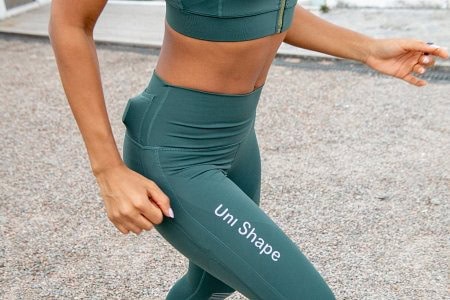
Two: changing clothes. This sounds trivial and isn’t. If movement requires changing into a specific outfit, it becomes an event. If it happens in what I’m already wearing, it’s just a bit more than I was doing anyway. The training garment I use now is worn next to the skin, so there’s no changing into anything, and that difference is bigger than it sounds.
Three: deciding what to do. Having to decide “what am I doing today” every single time is exhausting. My workaround was to make the decision in advance: pick a mode and let it run. More on that below, because it’s exactly where the equipment earns its place.
What I use, and how it’s put together
I use UniShape‘s smart EMS training system. Structure first, because there’s one thing here that’s easy to get wrong: it splits into two halves whose jobs don’t overlap at all.
Output side: UniShape smart EMS training system, contains a 30-gram electrical stimulation signal generator, roughly three hours of continuous use per charge, driving the electrodes in the garment. I use the women’s sports bra format. It runs two channels, meaning two independently driven outputs and two electrode pairs at once. The generator doesn’t measure anything.
Sensing side: UniShape smart EMS training system, contains a 4.2-gram smart ring. This is the only sensing device in the system. Every physiological reading, heart rate, ECG, blood oxygen, blood pressure trends, sleep and temperature, comes from that one ring.
Why a ring rather than a watch? Two reasons that connect directly to my schedule. First, it runs about seven days per charge, so I don’t have to remember to charge it daily. That matters a lot to me: anything that needs thinking about every day is something I’ll eventually forget, and then it quietly disappears from my life. With the 110-gram case in the loop, it’s roughly one charge every two weeks. Second, 4.2 grams genuinely can’t be felt; I wear it doing housework and sleeping without noticing.
The output half: two things that kept me using it
One, the intensity ramps rather than sitting still.
I cared about this more than I expected to. Years ago I tried a unit that held one intensity level for the whole session, and that “being gripped continuously” feeling is the reason I wrote off this entire category.
This one uses voltage-regulated output that steps up from low. The stated intent is to avoid holding muscle at one intensity for a long stretch. To be clear, that’s a design intent, not a promise about results; what it changes is how it feels, not what it achieves. But for me that difference is the difference between finishing and bailing at minute twelve.
Two, a session runs in phases, and I don’t have to manage them.
Session modes step through three phases automatically (warm-up, working, cool-down), each with a different pattern. That removes the third piece of friction I mentioned above: I don’t have to decide what today’s session is. I pick a mode and it goes.
But there’s one thing I only understood later, and it’s worth saying: the progression runs on a fixed timer, not on my heart rate. I assumed at first that it was reading my heart rate. It isn’t. Once I understood, I didn’t mind; between housework, carrying a child and general moving about, a heart rate reading drifts anyway. A system that jumps around because of that makes me less comfortable, not more.
And one sentence that has to be said clearly, because the misunderstanding is so widespread: the ring doesn’t control intensity. It’s a pure sensing device, not a remote control. To change intensity, I do it in the app. Adjusting it from the ring is something for later; it isn’t there now.
The sensing half: what it actually gives me
So what does all that sensing do for me? Two things.
One, it suggests, and then waits for me. The ring reads my heart rate continuously through a session, the app works out where the session has got to, and proposes a matching mode. And then it waits. If I don’t confirm in the app, nothing changes.
I found that “wait” annoying at first and now like it. I often have it running while I do housework, and the heart rate reading in that context isn’t precise. If it changed settings on its own initiative, I’d never notice. Because it asks, I do.
Two, it gives me two numbers, and I know they’re estimates. The app shows what the stimulation itself is estimated to account for, and the estimate for the period afterwards (EPOC, excess post-exercise oxygen consumption, the afterburn).
I look at them, and I’m clear that they’re inferred from heart rate, not measured; measuring expenditure properly takes a laboratory and gas exchange. So I use exactly one method with them: today against last Tuesday. That comparison means something, because the method is consistent. Comparing against someone else, or treating the figure as an absolute, doesn’t.
How it actually sits in my week
Specifically, because “I’ve started exercising lately” carries no information at all.
Morning: I run a session while the kettle boils, about twenty minutes. This is the reliable one, because it hangs off something that happens anyway: the water has to boil.
Afternoon or evening: another twenty minutes while my kid does homework and doesn’t need me every second. This one is unreliable; sometimes it happens, sometimes it doesn’t. My rule is: if it doesn’t happen, it doesn’t happen, and I don’t make it up. The moment I start making up sessions, it becomes a task, and tasks don’t survive two weeks in a fragmented schedule.
Non-training days: the ring stays on and logs sleep and resting data. That part is entirely passive: I do nothing and it records. For me that’s the most valuable part, precisely because it doesn’t need my cooperation.
Two practical worries, stated up front
Two things I hesitated over before starting, in case they help someone else hesitating.
One, washing. Whether clothing with electronics in it can be washed is a hard question to answer before buying. This one is machine washable, with three hard limits: a laundry bag, low-temperature water, and nothing above 50 °C, plus no tumble drying. Heat damages conductive fabric and electrodes. I wrote those three on a note next to the washing machine, because forgetting any one of them could ruin the garment.
Two, it’s in crowdfunding, not available now. The official line is that core components are stocked and delivery is listed at up to two months. Crowdfunding is crowdfunding, and timelines move, and if you want it now, this isn’t it. I’d worked that out before ordering, so there was no disappointment afterwards.
What it doesn’t do
Last, the part nobody mentions: what it doesn’t do.
It doesn’t diagnose anything. The ring records an ECG tracing, but it can’t identify atrial fibrillation, and it can’t identify any rhythm problem. That takes a validated medical device and a doctor. Blood pressure is the same: what the ring gives is a trend, the direction a number moves over weeks, not a single reading. For a blood pressure reading, use a cuff.
It also doesn’t replace medical advice of any kind. If something genuinely hurts, not the soreness after moving but pain that affects how you get through the day and is still there after several days of rest, the right move is a doctor, not turning the intensity up.
And one more, for the same reason: this is a fitness and training product, not a medical device. It doesn’t treat anything and doesn’t diagnose anything, and no FDA clearance or approval has been obtained. That includes the ring. Its readings are there to help me organise training, not to stand in for a doctor.
Getting those straight before I started using it made me more comfortable with it afterwards. Knowing where the boundary is means I don’t expect things from it that it can’t deliver.
A few things you could do today
Not a plan. Just the things that genuinely reduced friction on my side.
Hang movement on something that already happens. Kettle, washing machine, homework: find one thing that occurs every day without fail and attach twenty minutes to it. Far more reliable than “eight in the evening”.
Cut one step from the start. Count how many steps it takes to begin, then remove one. Changing clothes, finding the mat, deciding what to do; each is removable.
Allow some days to be nothing. My rule is “don’t make it up”. Making it up turns it into a task, and tasks don’t survive in a fragmented week.
Choose things that ask the least of you. I picked a seven-day ring over a watch that needs charging every night for exactly this reason. How much a thing needs from you decides how long it stays in your life.
Finally
I used to think what I needed was more time and more discipline. What I actually needed was to shrink the friction of starting until it was small enough not to count as an event.
It doesn’t happen every day, and I’m not in a good state every time. But because starting it takes so few steps that it barely registers as a thing I did, it has stayed in my week, which is more than I can say for any of the plans where I tried to find an hour.
